

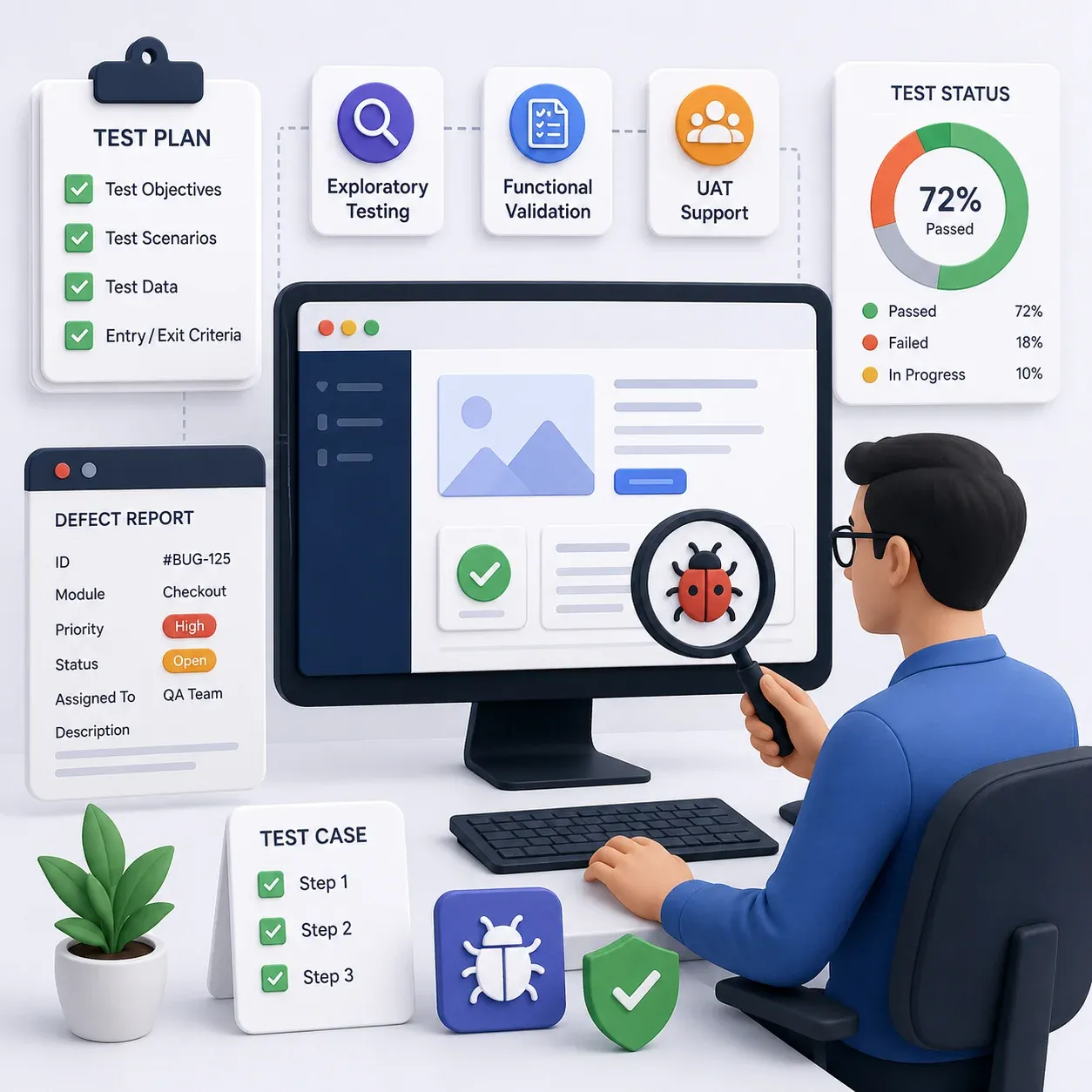
Test Planning & Strategy
Risk-based plans, scope definition, and coverage maps aligned to your release goals.

echoBitz provides structured manual testing: planning, exploratory sessions, functional validation, and UAT support. Clear defect reporting means your releases ship with confidence.
From early builds to release sign-off we combine structured test cases with exploratory insight to catch real user issues.
Risk-based plans, scope definition, and coverage maps aligned to your release goals.
Chartered exploratory sessions that uncover edge cases automation often misses.
Validate features against requirements across critical user journeys.
Help business users validate readiness with guided scripts and issue triage.
Clear, reproducible defect reports with severity, evidence, and impact context.
Release-ready checklists that protect core flows before every go-live.
A clear manual QA workflow that moves from risk analysis to actionable release confidence.
Understand product, risks, and release criteria.
Define scope, cases, and exploratory charters.
Run functional, exploratory, and regression checks.
Log defects with clear evidence and priority.
Summarize readiness and remaining risks.
We work with the tools your team already uses and bring clear process where it is missing.
We prioritize journeys and scenarios that matter most to users, revenue, and release confidence.
Validate features against requirements and acceptance criteria.
Spot friction, confusing flows, and experience issues early.
Check behavior across browsers, devices, and environments.
Support business validation with guided scripts and triage.
Explore unusual paths, data combinations, and failure modes.
Leave clear notes, cases, and evidence for future releases.
“Good manual QA is structured thinking, not random clicking.”
Scoped plan with risks, priorities, and entry/exit criteria.
Reusable cases and release checklists for critical flows.
Session charters and findings from exploratory testing.
Reproducible bugs with evidence, severity, and impact.
Pass/fail status, coverage, and remaining risk notes.
Release readiness summary for stakeholders.
echoBitz blends structured test design with exploratory skill so you catch both requirement gaps and unexpected user issues.
We focus human attention where product risk is highest new features, money flows, and journeys automation cannot fully judge.
Chartered sessions that surface issues scripts alone will miss.
Plans, cases, and reports your team can reuse every release.
Business-friendly scripts and triage that speed sign-off.
Defects prioritized by user and business impact.
Have questions about manual QA scope, timelines, UAT, or how we work with automation? Here are answers to common questions about manual testing projects with echoBitz.
Start a Manual QA ProjectTypical work includes test planning, functional cases, exploratory sessions, defect reporting, regression checklists, and a release readiness summary scoped to your product and timeline.
Manual testing is best for exploratory insight, usability judgment, and fast validation of changing features. Automation is best for repeatable regression. We often combine both.
Yes. We prepare guided UAT scripts, help triage findings, and summarize readiness so stakeholders can sign off with clarity.
A focused feature cycle may take days to a couple of weeks. Full release regression depends on scope and environments. We provide a clear plan after discovery.
Yes. We adapt to your tools and workflows, or help set up lightweight process if you do not have one yet.
Contact echoBitz for a free consultation. We review your product, release goals, and risk areas, then propose a tailored manual QA plan.