

Computer vision
Detection, classification, and OCR pipelines for images and video frames.
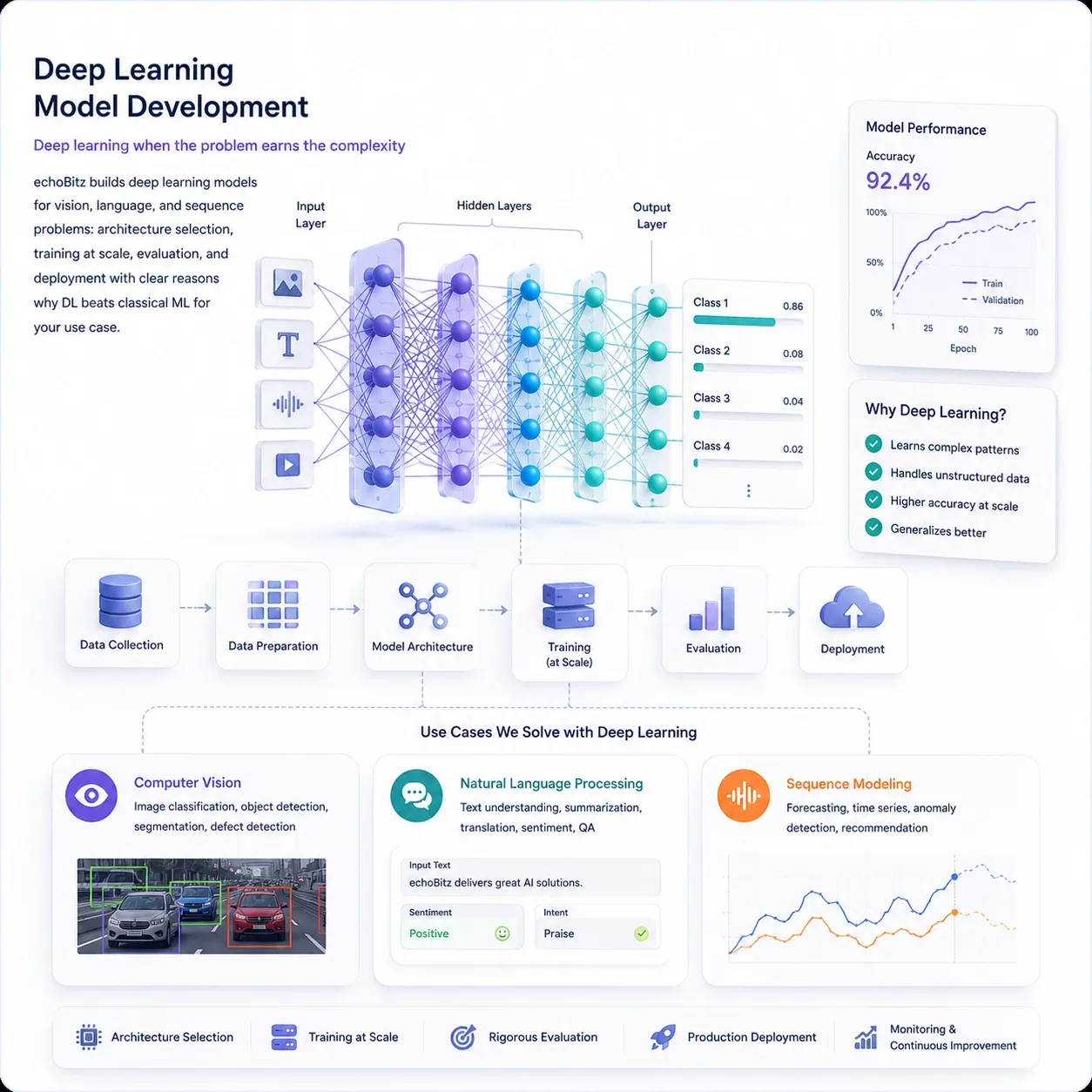
echoBitz builds deep learning models for vision, language, and sequence problems. Architecture selection, training at scale, and evaluation come with clear reasons why DL beats classical ML for your case.
When tabular ML is not enough vision, NLP, and sequential models done properly.
Detection, classification, and OCR pipelines for images and video frames.
Classification, extraction, and generation with evaluation beyond BLEU vibes.
Time-series and event sequences where deep architectures help.
Fine-tune strong backbones instead of training from scratch.
Quantization, batching, and GPU/CPU choices for cost and latency.
Holdout sets, error slices, and failure analysis before release.
Experiment discipline so deep models stay maintainable after launch.
Confirm modality, labels, latency, and why DL is justified.
Curate datasets, augmentations, and leakage-safe splits.
Select architecture, train with experiment tracking and checkpoints.
Validate on holdout and hard slices; compare to baselines.
Export, optimize, and deploy with monitoring and rollback.
Modern frameworks with experiment tracking and serving options.
We watch loss curves for overfitting and report task metrics that match the product decision.
Generalization signal during training.
Accuracy, mAP, F1, or WER chosen for the modality.
p95 inference time against your SLA.
Serving cost awareness for scale decisions.
Trainable, deployable DL assets not a one-off notebook.
Model choice, baselines, and justification documented.
Splits, labels, and augmentation recipe.
Versioned weights with training configs.
Holdout metrics, slices, and failure examples.
ONNX/TorchServe/API package ready to deploy.
Retrain triggers, GPU notes, and rollback steps.
We use DL when it earns the complexity. Then we train, evaluate, and serve with the same rigor we bring to classical ML and enterprise integrations.
We choose deep learning when the data and outcome justify it. Experimentation, compute, evaluation, and serving are then run as one accountable delivery process.
Answers about when to use deep learning, data needs, GPUs, and how echoBitz delivers DL models.
Start a DL ProjectWhen the signal is in images, language, or complex sequences and classical baselines are not enough. We compare before committing.
Training often benefits from GPUs. Serving may use GPU or optimized CPU depending on latency and cost.
Yes. Transfer learning and fine-tuning are preferred when labeled data is limited.
Proper splits, regularization, early stopping, and holdout evaluation on hard slices.
Yes via APIs, batch jobs, or edge/ONNX packages depending on the use case.
Contact echoBitz to start a DL project. We review modality, data, and SLAs, then propose an architecture and pilot plan.