


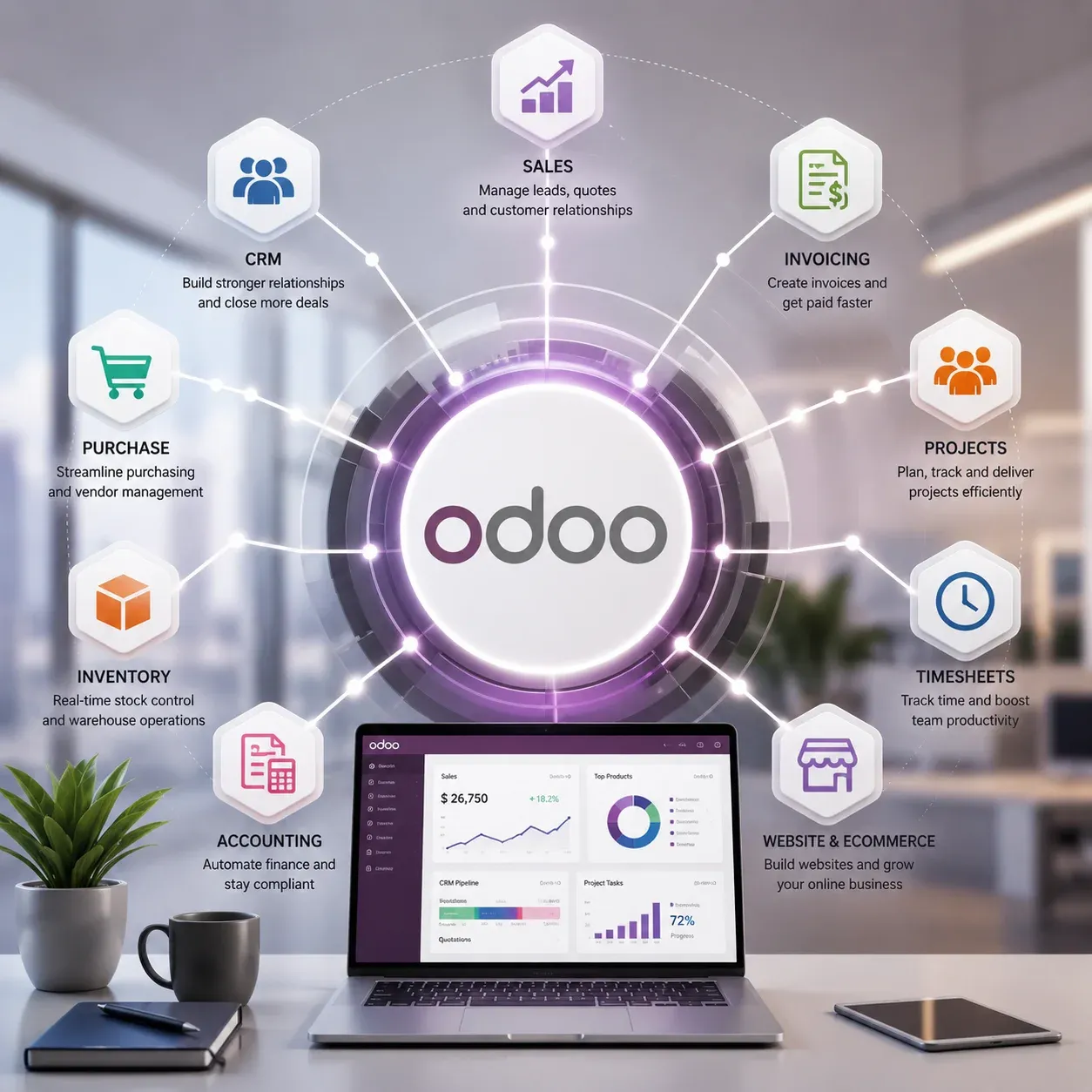
Most businesses do not set out to build a patchwork of disconnected software. It happens gradually: a spreadsheet becomes the inventory system, a separate tool handles invoicing, the sales team adopts its own CRM, and a project management app runs alongside all of it with no shared data. Each choice made sense in isolation. Together, they create an operation where nobody has a single reliable answer to a simple question like how much of a given product is actually available to sell today. This is the specific problem that draws many growing businesses toward an integrated ERP platform like Odoo.
The real cost of disconnected systems
When systems do not share data, someone has to move it manually, and manual movement is where errors, delays, and inconsistent records accumulate. A sales order confirmed in one system may not update stock levels in another until someone remembers to enter it. An invoice generated separately from the order that created it can drift out of sync when either one changes. None of these problems are dramatic on their own, but they compound. Reporting becomes a process of reconciling numbers from different sources rather than pulling a single reliable figure, and every reconciliation is time spent not growing the business.
What Odoo brings together
Odoo is structured as a suite of connected applications built on a shared data model, covering CRM, sales, accounting, inventory, purchase, the website and eCommerce, point of sale, project management, marketing, and HR, among others. The specific value is not that each individual application is the most feature-rich option available in its category on its own. It is that a sales order, a stock movement, an invoice, and a customer record all reference the same underlying data, so an update in one place is visible everywhere else without a manual sync step. A business does not have to adopt every application at once; most Odoo implementations start with the two or three modules that address the most pressing operational gap, then extend into other areas as the team becomes comfortable with the platform and the data behind it matures.
What changes when systems are actually connected
- One source of business data, so finance, sales, and operations work from the same customer, product, and transaction records instead of reconciling different versions.
- Better visibility into what is actually happening across the business, since a manager can see order status, stock levels, and financial position without switching between disconnected tools.
- Reduced manual data entry, because information created in one application is available to the others without being retyped.
- Connected workflows, where a confirmed sale can automatically trigger the relevant stock reservation, delivery, and invoicing steps instead of requiring separate manual actions.
- Easier reporting, built from a single consistent dataset rather than assembled from exports pulled out of several disconnected systems.
- Better collaboration between departments that previously worked from separate records of the same customer or project.
Where AI adds value on top of an ERP foundation
An integrated ERP creates something that a collection of disconnected tools cannot: a large, consistent, well-structured dataset describing how the business actually operates. That foundation is exactly what makes AI genuinely useful rather than speculative. On top of Odoo, AI can help analyze business data to surface trends or anomalies a manual report would miss, assist employees with drafting communications or summarizing records without leaving the application they are already working in, automate repetitive workflows such as data entry or routine approvals, support decisions with relevant context pulled from connected records, and surface information buried in notes or historical transactions that would otherwise require a manual search.
Odoo is a foundation, not a complete fix
It is worth being direct about what an ERP does not do. Implementing Odoo does not automatically fix a broken sales process, resolve unclear ownership between departments, or eliminate the need for good data discipline. A business that migrates disorganized, inconsistent data into a new system will simply have disorganized, inconsistent data in a more connected environment. The platform gives a business the structure to operate with one shared source of truth; the business still has to define its processes, assign ownership, and maintain the quality of the data it puts in.
The appeal of Odoo for a growing business is rarely about any single feature. It is about replacing a set of disconnected tools with one platform where sales, operations, and finance work from the same information, and where the resulting data is clean and structured enough to support genuinely useful automation and AI on top of it. That combination — an integrated operational backbone, plus the AI capabilities that become possible once the data is trustworthy — is why more operations leaders are treating ERP selection as a foundational technology decision rather than a back-office software purchase.
Comments (00)