


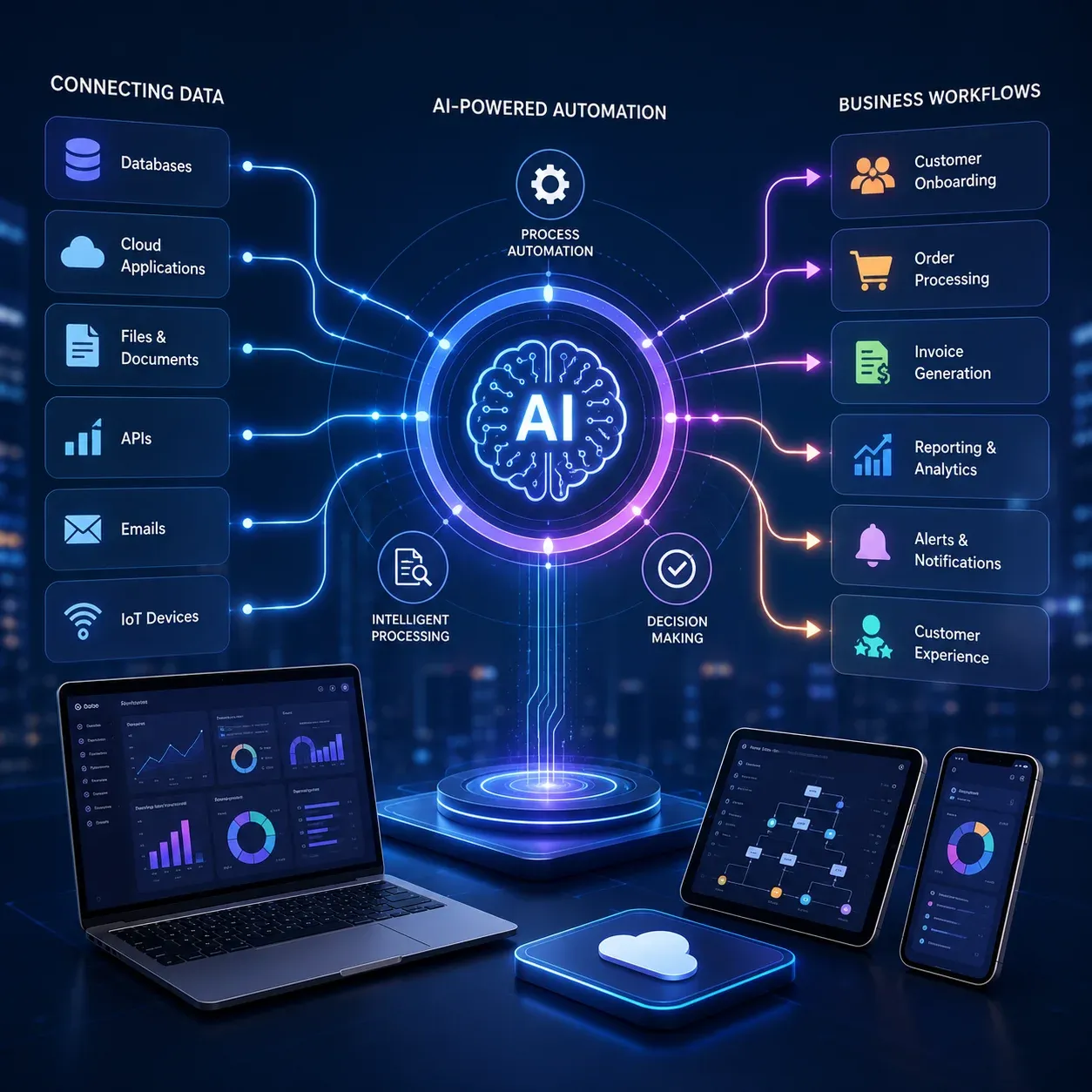
A growing business rarely runs on one piece of software. Between the CRM, the ERP, marketing tools, a support platform, internal applications, and a long list of specialized SaaS tools, most organizations end up with a technology stack that reflects years of separate purchasing decisions rather than one coherent design. Each tool does its job well in isolation. The problem shows up in the space between them, where data has to move manually or not at all.
The integration problem behind every growing tech stack
When a new lead fills out a form on the website, does it appear automatically in the CRM, or does someone export a spreadsheet and upload it? When a deal closes, does the ERP know to start fulfilment, or does a person re-enter the order by hand? Every manual handoff between systems is a point where delay, duplication, or simple human error can enter the process. As a business adds more tools to solve more specific problems, the number of these handoffs grows faster than most teams notice, until keeping data consistent across systems becomes a quiet, ongoing tax on everyone's time.
Four different levels of "automation"
These terms get used interchangeably, but they describe meaningfully different levels of capability:
- Simple automation: a single trigger-and-action rule, such as sending a notification when a form is submitted, with no broader system awareness.
- Integration workflows: a defined, multi-step process that moves and transforms data between two or more systems, such as syncing a new customer from a CRM into an ERP with the correct field mappings.
- AI-assisted workflows: an integration workflow where a step involves a model interpreting unstructured input, such as classifying an inbound support request before routing it to the right system and team.
- AI agents: a system that can reason about a goal and decide which steps and tools to use to reach it, rather than following a single predefined path.
Most business automation in production today sits in the first two categories, and that is not a limitation. A large share of the value in connecting business systems comes from reliable, well-designed integration workflows long before any AI is involved.
Where a platform like Tray.ai fits
Integration and automation platforms such as Tray.ai are designed to help organizations build these workflows without requiring a custom point-to-point connection between every pair of systems. Using API-based connections, a workflow can move data between a CRM, an ERP, a support platform, and other applications on a defined schedule or in response to an event, applying validation and transformation rules along the way. As AI capabilities are layered into these platforms, workflows can also include steps where a model classifies, summarizes, or drafts content as part of the automated sequence, rather than requiring a person to handle that step manually before the data continues on its path.
What makes automation scalable rather than fragile
- Reliable error handling, so a failed step is retried or flagged rather than silently dropping a record.
- Clear data mapping between systems, so a field means the same thing on both sides of an integration.
- Monitoring and visibility into what a workflow actually did, not only what it was configured to do.
- Governed access, with credentials and permissions scoped to exactly what each workflow needs and nothing more.
A workflow built without these fundamentals may work in a demo and still fail quietly in production, moving on to the next task without anyone noticing that a step returned bad data.
AI works best inside connected systems
The more ambitious goal of using AI agents to complete multi-step business tasks depends entirely on this same integration layer. An agent that is supposed to update a CRM record, check inventory, and send a confirmation still needs a reliable connection to each of those systems, with the same data mapping, error handling, and permission boundaries that any integration workflow requires. AI reasoning does not replace the need for solid integration; it depends on it. The businesses positioned to make real use of AI agents are, in most cases, the ones that already invested in connecting their systems reliably.
Enterprise automation rarely fails because a business chose the wrong platform. It fails because workflows were built without enough attention to error handling, data mapping, and visibility into what actually happened when something went wrong. Whether the workflow is a simple two-system sync or a more ambitious AI-assisted process, the same discipline applies: connect systems deliberately, monitor what the automation is actually doing, and treat integration as core infrastructure rather than an afterthought bolted on after every new tool is purchased.
Comments (00)