


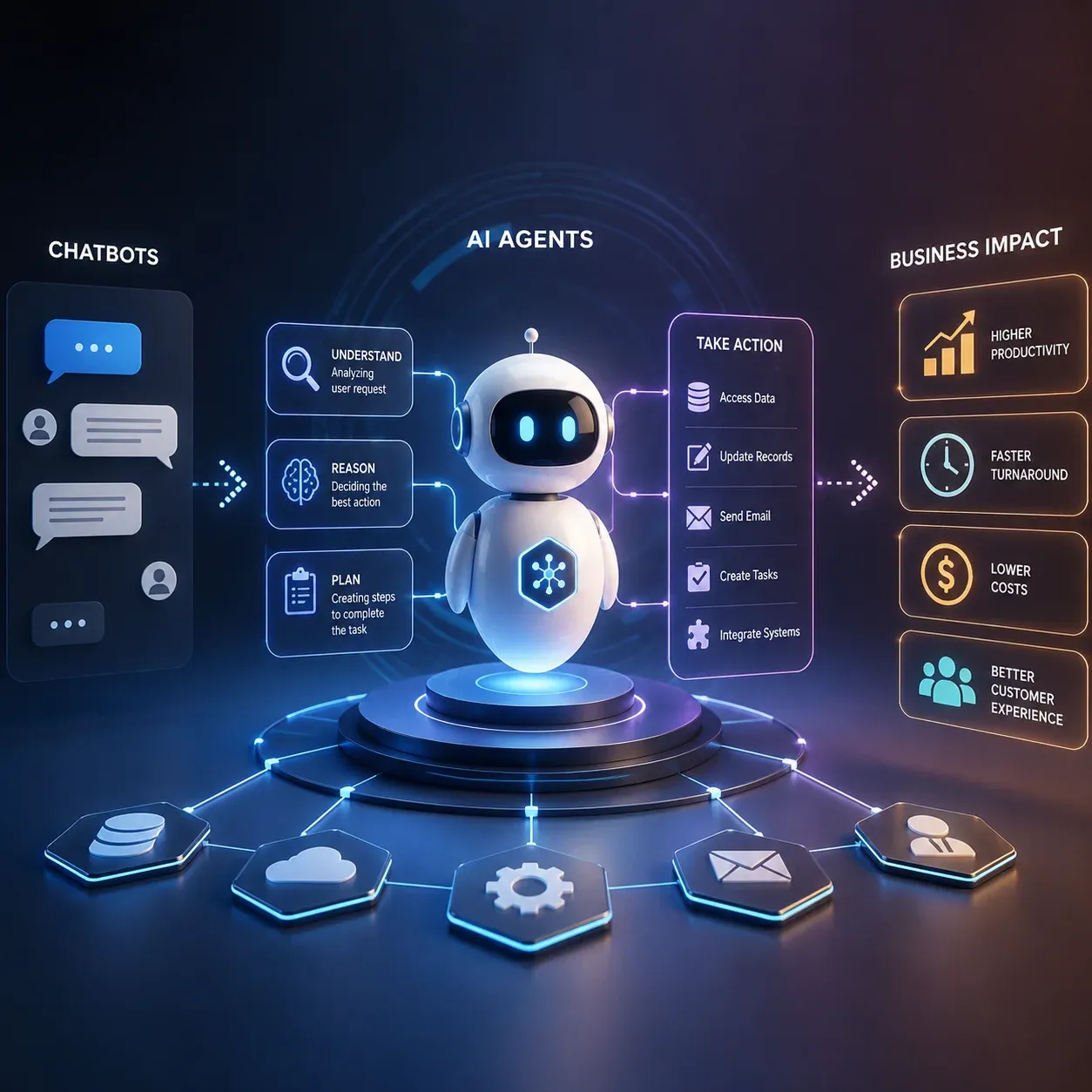
Every few years a new label attaches itself to business software and gets used so broadly that it stops meaning anything specific. "AI agent" is at real risk of becoming one of those labels. Vendors apply it to chatbots, to workflow automations, and to genuinely new systems that can plan and execute multi-step tasks. For a business evaluating where to invest, it is worth being precise about what actually separates an agent from the automation and chat tools that came before it.
From rule-based automation to agentic workflows
Traditional software automation follows an explicit, predetermined path: if a field changes, trigger this action; if a form is submitted, send this email. It is reliable because it does exactly what it was configured to do, and only that. A chatbot adds a conversational layer on top of a similar structure, usually retrieving an answer from a knowledge base or a fixed set of responses. An AI assistant goes further, using a language model to draft or summarize content on request, but it still waits for a person to decide what happens with that output. An AI agent is different in one important respect: given a goal, it can decide which steps are needed to reach it, use tools to carry those steps out, and adjust if something does not go as expected — within boundaries a person has defined in advance.
What an agent actually does, step by step
Stripped of the marketing language, most working definitions of an AI agent describe a similar sequence:
- Understands a goal stated in natural language, such as "qualify this inbound lead" or "summarize this week's support escalations."
- Reasons about what information and steps are needed, breaking a broad request into a sequence of smaller actions.
- Retrieves relevant information from connected systems, such as a CRM record, a knowledge base article, or a previous support ticket.
- Uses tools it has been granted access to, such as sending an email, updating a record, or querying an API, rather than only generating text.
- Executes multiple steps in sequence, carrying context from one step into the next instead of treating each action in isolation.
- Checks its own results against the original goal before considering a task complete, catching some errors before a human ever sees them.
- Escalates to a person when the task falls outside its defined scope, the data is inconsistent, or confidence in an action is low.
What this looks like in practice
The examples that come up most often in real business deployments are narrower and less dramatic than the term "agent" suggests:
- Customer support: an agent reads an incoming ticket, checks the customer's order history, drafts a response, and either sends a routine reply automatically or routes anything unusual to a support agent with the relevant context already attached.
- Sales operations: an agent reviews a new inbound lead against qualification criteria, enriches the record with information already available in the CRM, and creates a task for a sales rep only when the lead meets the defined bar.
- Internal operations: an agent prepares a recurring report by pulling figures from multiple systems, formatting them consistently, and flagging any number that falls outside an expected range for a person to review before distribution.
- Research and information gathering: an agent collects and organizes information from internal documents and approved sources in response to a specific question, instead of requiring an employee to search several systems manually.
Why "autonomous" is the wrong word for what works
The version of an AI agent that makes headlines is fully autonomous, acting without any human involvement. The version that actually holds up in a production business environment is closer to a well-supervised employee: given a defined scope, granted specific permissions, and expected to ask before doing anything it was not clearly authorized to do. Framing agents as autonomous magic tends to produce one of two outcomes: either the business grants far too much unsupervised access and gets caught out by an edge case nobody anticipated, or the business becomes so cautious after hearing about that risk that it never deploys anything useful at all.
What production-ready agents require
- Clear permissions defining exactly which systems, records, and actions the agent can touch, following the same least-privilege principle applied to any employee or service account.
- Reliable, well-structured data, since an agent making decisions from inconsistent or outdated records will act on that inconsistency with confidence rather than catching it.
- Human oversight at defined checkpoints, particularly for actions that are costly to reverse, such as sending external communication or modifying financial records.
- Security controls consistent with any system that can act on business data, including authentication, logging, and separation between development and production access.
- Monitoring that surfaces what the agent did, not only what it was asked to do, so unexpected behavior is visible quickly rather than discovered later.
- Evaluation against defined success criteria, so a team can say with evidence whether the agent is performing the task correctly rather than relying on impression.
- Auditability, meaning every action can be traced back to the input that triggered it and the rule or reasoning that permitted it.
The organizations getting real value from AI agents are not the ones that deployed something fully autonomous and walked away. They are the ones that treated an agent the way they would treat any new system with access to business data and customer-facing actions: with defined scope, tested permissions, monitored behavior, and a clear path for a human to step in. Built that way, an agent is not a replacement for business judgment. It is a way to apply consistent, well-defined judgment to a much larger volume of routine work than a team could otherwise keep up with.
Comments (00)